The Missing Half

For the past two weeks, we’ve been living in a state of quiet awe. The decision to build our own persistence layer—to treat the database as a simple, file-backed JavaScript object—paid off beyond our expectations. The "wall of mud" we hit when trying to integrate a traditional database was gone. The entire data flow, from the logic on the server to the bits on the disk, was seamless. It felt pure.
We had successfully built a perfect, one-way street for displaying data. Then, we tried to build a simple form, and our beautiful street led straight off a cliff.
Our first idea seemed beautifully symmetric. If the UI is a mirror of the server state, why not make it a two-way mirror? We tried to directly bind an input field to the server state.
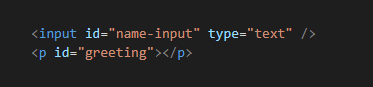
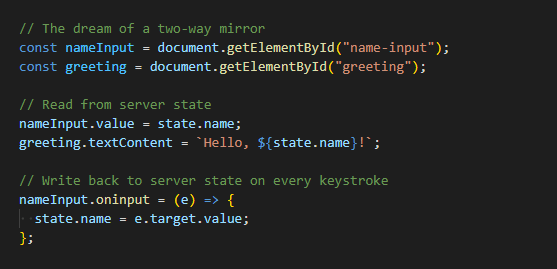
On paper, it was perfect. In practice, it was a disaster. The input delay was entirely perceptible and soul-crushing. You'd press a key, and for a fraction of a second, your brain would register the action but the screen would show nothing. Then, the character would pop into existence. Typing felt like wading through molasses. Every single keystroke had to make a full round trip: client -> server -> back to all clients. The "nervous system" we were so proud of had created a form with a debilitating neurological disorder.
We were so close. The one-way data flow was instant. But this two-way binding, the most intuitive approach, was fundamentally broken by the speed of light.
Our next attempt was a compromise. We created a special server() function. It wasn't as elegant as direct binding, but it was better than a full REST API. The idea was to handle user input only on a specific event, like a button click. To get data from the client to the server, you'd pass it as an argument.
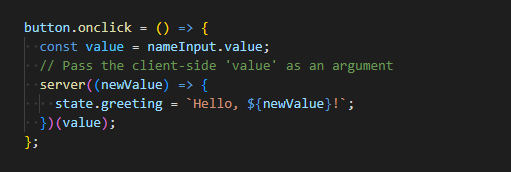
It worked. The lag was gone because we were only sending data on the click. But the developer experience was a compromise. That syntax—server((arg) => { ... })(arg)—is a tax. It's a constant reminder of the boundary you're crossing. It's boilerplate you have to write every single time. It broke the spell.
We refused to ship a compromise. The developer experience had to be perfect, or the entire premise was a failure. **We refuse to write boilerplate syntax to appease a compiler or a framework. The tool must bend to the developer, not the other way around.**
That refusal sent us into a spiral. We locked ourselves in for a marathon session that bled from one day into the next. The whiteboard became a graveyard of failed ideas. Around hour ten, someone had the idea: "What if we just added a build step? A compiler could analyze the code and rewrite it to hide the ugliness."
The room went quiet. A build step. It was a cardinal sin against our philosophy of "zero." It meant configuration. It meant setup. It meant a developer couldn't just write code and run it. It was a huge DX loss, and it was unacceptable. We erased it from the board.
By the fourteenth hour, under the hum of fluorescent lights and fueled by stale coffee, despair began to set in. Maybe we were chasing a ghost. Maybe the perfect, zero-boilerplate DX we wanted was simply impossible, a naive dream. We started to doubt ourselves. Were we just being stubborn? Maybe the version with arguments was "good enough." We were on the verge of giving up, of accepting the compromise just to move on.
Then it happened.
It wasn't a single line of code, but a shift in perspective. We were trying to send data _to_ a function. What if the function could just... reach out and grab it? What if we could create a closure that was somehow aware of its lexical scope, even across the network, without a build step?
We don't have the words to explain exactly how it works yet. It feels like a magic trick we just taught ourselves. But the result is everything we dreamed of.
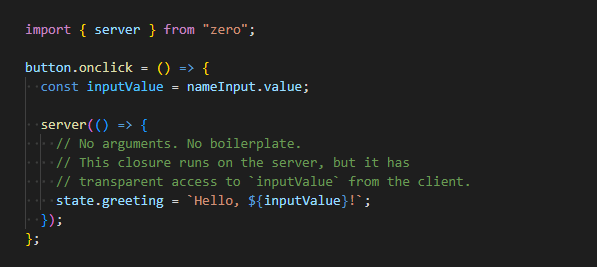
We ran it. We typed a name into the box. We clicked the button. The greeting updated instantly. The code was clean. The developer writes a normal event handler. They define a constant from a DOM element, just like they always would. Then they open a server block and just... use that constant. The boundary is gone.
We had found the missing half. We had stared into the abyss of compromise and refused to blink. And on the other side, we found the magic we were looking for all along.
This was more than just a clever function. It was a validation of our entire philosophy. The doubts that crept in during that long night have vanished. For the first time, we are no longer just experimenting; we are building. We are now convinced, with total certainty, that we are on the right path.